Values-Based Excellence and Quality TVET Systems: Building Trust, Relevance, and Sustainable Impact
As countries across Africa continue to invest in Technical and Vocational Education and Training (TVET), there is growing recognition that expanding access alone is not enough. The true measure of success lies not in the number of institutions or enrolled learners, but in the quality, relevance, and impact of the skills systems being built.
The Continental TVET Strategy, led by the African Union, emphasizes a critical principle: TVET systems must be grounded in values-based excellence. This means shifting focus from expansion without direction to strengthening systems that are effective, accountable, inclusive, and responsive to evolving economic needs.
Values-based excellence represents a transformation in how skills systems are designed, governed, and evaluated. It calls for TVET institutions and regulatory bodies to prioritize outcomes over inputs, quality over quantity, and long-term impact over short-term metrics.
This approach requires TVET systems to be:
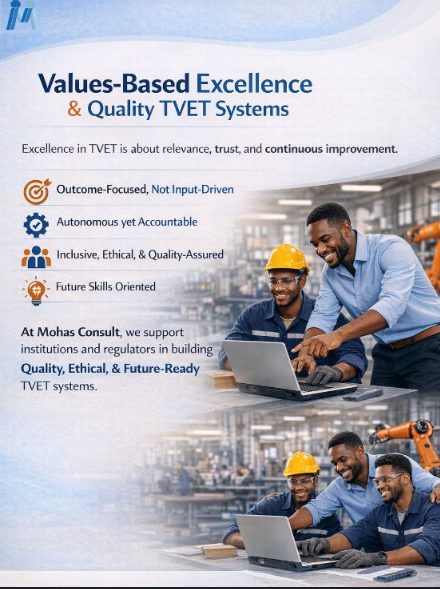
• Outcome-focused, not input-driven – Success must be measured by graduate employability, competency, and career progression, rather than simply enrollment numbers or infrastructure expansion. The ultimate goal is to ensure that learners acquire skills that translate into meaningful employment and economic participation.
• Autonomous yet accountable – Institutions must have the flexibility to innovate, respond to industry needs, and improve their programs. At the same time, they must operate within strong accountability frameworks that ensure transparency, performance, and public trust.
• Inclusive, ethical, and quality-assured – TVET systems must serve diverse populations, including youth, women, and underserved communities. Quality assurance mechanisms are essential to ensure that training meets established standards and maintains credibility among employers and learners alike.
• Capable of anticipating future skills needs – Skills systems must not only respond to current labor market demands but also anticipate emerging sectors, technological changes, and future workforce requirements. This requires strong data systems, labor market intelligence, and continuous adaptation.
Building such systems requires more than policy—it requires strong institutions with the capacity, leadership, and governance structures to implement and sustain quality.
At Mohas Consult, we work closely with governments, regulatory authorities, and training institutions to strengthen the foundations of quality TVET systems. Our support focuses on developing structures and capacities that enable institutions to deliver consistent, credible, and future-ready training.
This includes supporting:
• The design and implementation of quality assurance frameworks that ensure training programs meet defined standards and produce competent graduates
• The development of performance-based governance systems that strengthen institutional accountability, transparency, and effectiveness
• Trainer and leadership capacity development, enabling instructors and institutional leaders to deliver high-quality, competency-based training and drive continuous improvement
• The establishment of Recognition of Prior Learning (RPL) systems, which formally recognize skills acquired through informal and non-formal learning pathways, expanding opportunities for workers and strengthening workforce mobility
These efforts contribute to building TVET systems that are trusted by employers, valued by learners, and aligned with national and regional development goals.
Excellence in TVET is not about prestige, branding, or institutional status. It is about relevance—ensuring that training reflects real economic needs. It is about trust—ensuring that employers have confidence in the competencies of graduates. And it is about continuous improvement—ensuring that institutions evolve alongside changing industries and technologies.
Strong institutions create strong skills systems. And strong skills systems create the foundation for inclusive growth, innovation, and long-term economic resilience.
At Mohas Consult, we remain committed to supporting partners in building TVET systems that are not only expanded—but strengthened through quality, integrity, and values-based excellence.