From Skills Mismatch to Employability for All
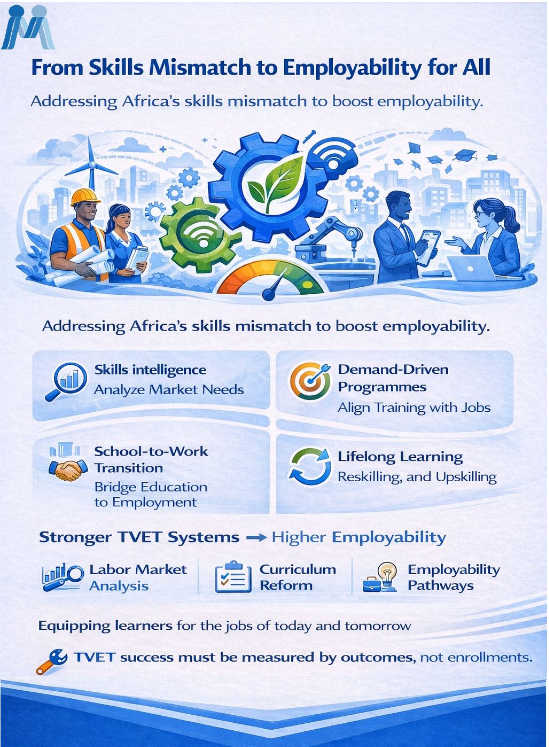
Across Africa, one challenge continues to limit inclusive growth and decent work: skills mismatch. While millions of young people enter the labor market each year, many employers still struggle to find candidates with the right technical, practical, and soft skills. This disconnect not only slows economic progress—it also affects livelihoods, productivity, and long-term national competitiveness.
The African Union, through its Continental TVET Strategy, sends a clear and timely message: transforming Technical and Vocational Education and Training (TVET) systems is essential to closing the skills gap and building resilient economies.
The Strategy highlights several critical priorities:
✔ Skills intelligence and labor market forecasting – using real data to anticipate sector growth, emerging occupations, and future skills demand.
✔ Demand-driven, competency-based programmes – ensuring training reflects industry standards and workplace realities.
✔ Stronger school-to-work transition systems – connecting learners to internships, apprenticeships, and meaningful employment pathways.
✔ Lifelong learning, reskilling, and upskilling – enabling workers to continuously adapt in a rapidly changing economy.
These priorities reflect a simple but powerful shift: TVET systems must move from supply-driven training to demand-responsive ecosystems.
At Mohas Consult, we work alongside governments, training institutions, development partners, and private sector actors to translate strategy into practical, measurable results. Our support includes:
• Comprehensive labor market and sector skills analysis to identify priority occupations and growth industries
• Curriculum modernization and occupational standards reform aligned with competency-based frameworks
• Development of assessment and certification systems that ensure quality and credibility
• Designing employability and entrepreneurship pathways that support both wage employment and self-employment
We believe employability is not accidental—it is intentionally designed. It requires reliable data, strong partnerships between training providers and industry, quality assurance systems, and a shared commitment to outcomes.
TVET success should not be measured by enrollment numbers alone. It must be evaluated by real-world impact:
🔧 Are graduates employed?
🔧 Are employers satisfied with their competencies?
🔧 Are workers progressing in their careers and contributing to economic growth?
When skills systems are aligned with labor market realities, everyone benefits—learners, employers, and the broader economy.
From skills mismatch to employability for all, the path forward is clear: evidence-based planning, industry engagement, and quality-driven implementation.
At Mohas Consult, we are committed to helping make that transformation a realit