Partnerships & Co-Creation with the Productive Sector: A Foundation for Effective TVET Systems
Sustainable skills development cannot happen in isolation. Across Africa, there is growing recognition that Technical and Vocational Education and Training (TVET) systems must be built in close partnership with the productive sector—the employers, industries, and enterprises that ultimately absorb skilled workers. Without their active involvement, training risks becoming disconnected from real workplace needs.
The African Union Continental TVET Strategy makes this point clear and unequivocal: the productive sector must not be viewed merely as a beneficiary of skills systems, but as a co-creator. Employers are not passive recipients—they are essential partners in shaping relevant, responsive, and future-oriented training systems.
This approach represents a fundamental shift from traditional models where training institutions operate independently, often without sufficient alignment with industry realities. Instead, the Strategy promotes collaborative frameworks where industry voices help guide every stage of the skills development cycle.
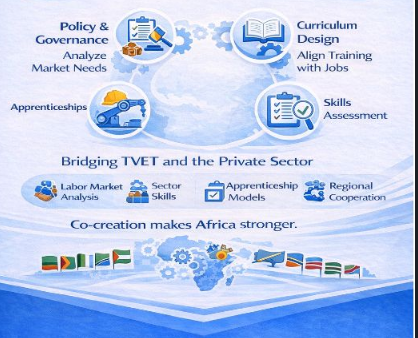
This includes partnerships across several key areas:
• Policy and governance – Ensuring that employers and sector representatives contribute to national skills strategies, regulatory frameworks, and decision-making bodies. Their insights help ensure policies reflect economic priorities and workforce needs.
• Curriculum design and delivery – Engaging industry experts in defining occupational standards, competencies, and training content so learners acquire skills that are directly applicable in the workplace.
• Apprenticeships and work-based learning – Expanding opportunities for learners to gain hands-on experience through structured apprenticeships, internships, and dual training models that combine classroom learning with real work environments.
• Assessment, certification, and skills anticipation – Aligning certification systems with industry expectations and using labor market intelligence to anticipate emerging skills demands and future workforce trends.
These partnerships strengthen both the relevance and the credibility of TVET systems. When employers are actively involved, training becomes more practical, graduates are better prepared, and the transition from education to employment becomes smoother and more efficient.
At Mohas Consult, we work with governments, training institutions, private sector organizations, and development partners to design and strengthen these collaborative ecosystems. Our focus is on creating sustainable structures that enable meaningful engagement, not just one-time consultations.
Our work supports:
• The development of structured public-private partnerships that clarify roles, responsibilities, and shared objectives
• The establishment and strengthening of sector skills bodies and social dialogue platforms that facilitate continuous engagement between education and industry
• The design and implementation of dual training and apprenticeship models that integrate workplace learning as a core component of training systems
• The promotion of regional and cross-border cooperation, enabling countries to share knowledge, harmonize standards, and address common skills challenges
These efforts help build skills systems that are responsive, inclusive, and resilient.
No single institution—whether government, training provider, or private company—can solve skills challenges alone. The scale and complexity of workforce transformation require collective action, shared ownership, and continuous collaboration.
Co-creation ensures that training systems remain dynamic and relevant. It enables faster adaptation to technological change, evolving industry demands, and new economic opportunities. It also strengthens trust between stakeholders and ensures that investments in skills development translate into real employment outcomes.
Africa’s greatest strength lies in its ability to collaborate, share knowledge, and innovate collectively. By placing partnerships at the center of TVET reform, countries can build systems that empower individuals, support businesses, and drive sustainable economic growth.
At Mohas Consult, we remain committed to supporting this transformation—helping partners design and implement skills systems that are not only inclusive, but truly aligned with the needs of the productive sector.